

Co-Authored by Element8 and Concera. Cost Analysis done by Concera.
- 25:00 min
Table of Contents
Walk into any mining operation, processing plant, or manufacturing facility across South Africa, and there is a good chance the SCADA system running the show was installed a decade or more ago. The software may look familiar, the engineers may know it well, and the operations team may consider it stable. But stable and cost-effective are not the same thing.
The real question is not whether your current system still works. It is how much it is quietly costing you – in licensing, infrastructure, vendor dependency, and missed opportunity – and whether that cost is something your organisation can keep absorbing over the next ten years.
“Many industrial organisations are not evaluating the true cost of their legacy SCADA. They are comparing the visible line items – not the compounding financial and operational burden that builds up over time.
The real question is not whether your current system still works. It is how much it is quietly costing you – in licensing, infrastructure, vendor dependency, and missed opportunity – and whether that cost is something your organisation can keep absorbing over the next ten years.”
Why Legacy SCADA Is Becoming a Financial Liability
Legacy SCADA platforms were designed for a different era. They solved the problems of their time – reliable data acquisition, basic HMI visualisation, and on-premise historian logging. But the industrial environment has changed significantly, and the architecture of these systems has not kept pace.
Today’s operations demand more. They need real-time visibility across multiple sites, seamless integration with ERP, MES, and cloud systems, mobile access for field engineers, and a cybersecurity posture that meets IT department requirements. Legacy systems were not built for any of this – and retrofitting them to get there is expensive.
The pressure to modernise is coming from several directions at once:
- Digital transformation mandates from leadership and shareholders
- Data visibility – increased demand for production data and enterprise reporting
- IT/OT convergence – the need to integrate operational data with business systems
- Cybersecurity requirements that legacy architectures struggle to meet
- Skills scarcity – finding engineers who still work on ageing platforms is becoming harder
1. The Licensing Problem: Why the Bill Keeps Growing
One of the most significant differences between legacy SCADA platforms and modern solutions like Ignition lies in their fundamental licensing philosophy. Understanding this is key to understanding the total cost of ownership.
1.1 How Legacy Licensing Works
Traditional SCADA platforms are built around a consumption-based model. You pay for what you use, and as your system grows, so does your cost:
- Per-tag licensing: the more process variables you monitor, the more you pay
- Per-client licensing: every operator workstation or engineering PC requires a paid seat
- Per-server licensing: each additional server node adds to the bill
- Annual maintenance contracts: typically 18–22% of the original purchase price per year
- Upgrade cycles: major version upgrades often require repurchasing or significant additional investment
“As a system grows – more tags, more users, more sites – the licensing cost scales proportionally. What started as a manageable investment becomes a compounding financial commitment.”
1.2 How Ignition Licensing Works
Ignition by Inductive Automation takes a fundamentally different approach. It is a server-based licensing model built on an unlimited-use philosophy:
- Unlimited tags: monitor as many process variables as your operation requires
- Unlimited clients: every operator, engineer, and manager can access the system – no per-seat fees
- Unlimited devices: connect PLCs, instruments, and devices without paying per connection
- Modular architecture: add functionality (MES, Reporting, Alarming, Perspective) as needed
- Fixed annual support: Ignition BasicCare is 16% of the initial purchase price – locked in at purchase, never increasing with inflation or market changes
“It is also worth noting what Ignition does not do: there are no hidden licence tiers, no feature-gating behind higher-cost editions, and no surprises when you go to renew. The licensing model is transparent and publicly documented – you know exactly what you are paying for, what is included, and what any additions will cost, before you sign anything.”
The result is a system that encourages growth rather than penalises it. You can scale from 10,000 tags to 150,000 tags, add 50 new operator screens, and connect three new sites – without receiving a licensing invoice.
2. Upgrade Protection: Why the Support Fee Is One of the Best Investments You Can Make
One aspect of Ignition’s support model that often surprises organisations is what the annual fee actually includes. This is not simply a helpdesk ticket. Every active support plan – starting with BasicCare at 16% per year – includes full Upgrade Protection.
In practical terms, this means that as long as your support plan is active, every major version release of Ignition and all your licensed modules is included at no additional cost. Inductive Automation releases major versions regularly, each bringing expanded capabilities, new modules, performance improvements, and security updates.
65%
The cost of upgrading Ignition without an active support plan – calculated as a percentage of the software’s current retail price.
With BasicCare active at 16% per year, that same upgrade is included. The support plan pays for itself the first time a major version drops.
The three support tiers are structured as follows:

There is one important nuance worth knowing: the annual support price is calculated based on the retail price of your software at the time of purchase and is billed per activation key. Critically, the base support fee does not escalate with market price increases over time – your cost is anchored to what you paid at the outset.
For industrial operations running mission-critical systems, the ability to receive major version upgrades – including security patches, new drivers, expanded module capabilities, and platform improvements – without budgeting for a separate upgrade project every few years is a significant operational and financial advantage. The 10-year cost is predictable from Year 1. No surprise upgrade invoices, no per-seat expansion costs, no vendor-driven price increases.
3. The Hidden Costs That Never Show Up in a Quote
When organisations compare SCADA platforms, they often focus on the initial purchase price. That comparison is almost always misleading. The real cost of a SCADA system builds up across three dimensions that traditional vendor proposals rarely surface clearly.
3.1. Licensing Costs That Compound Over Time
Tag counts grow. Operations expand. New production lines get added. Each of these events triggers an additional licensing cost on a legacy platform. Over 10 years, an organisation that starts with 10,000 tags and grows to 50,000 tags will face a substantially higher licensing bill – one that was never fully visible at the point of purchase.
3.2 Third-Party Driver Costs That Add Up Quietly
Legacy SCADA platforms often do not include native drivers for the full range of PLCs and devices on your plant floor. This means organisations frequently need to purchase and maintain third-party communication middleware – such as Kepware or TopServer – just to connect their existing hardware. These are separate licences, separate maintenance contracts, and separate points of failure. Ignition takes a different approach: the most common industrial drivers are bundled with the platform at no extra cost, including OPC-UA, Modbus, Allen-Bradley, Siemens S7, and many others. In most implementations, this alone eliminates a line item that organisations did not realise they were paying for.
3.3 Infrastructure Costs That Legacy Systems Demand
Many traditional SCADA platforms require a domain controller – a Microsoft Active Directory server that must be managed, maintained, and licenced by IT. This creates a dependency on IT infrastructure, adding both cost and complexity. Compare this to Ignition, which requires only a single gateway server and can run on Windows, Linux, or even a virtual machine – no domain controller needed.
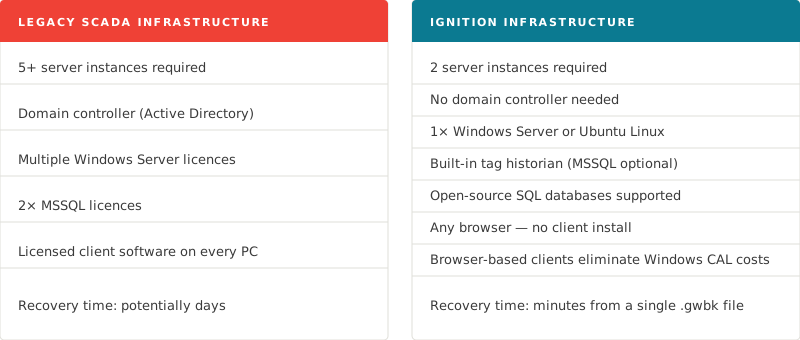
With Ignition, a fully redundant gateway setup – where a second server automatically takes over if the primary fails – is available at just 50% of the primary licence cost. This makes enterprise-grade redundancy genuinely accessible, rather than a premium that most organisations quietly skip because it doubles the bill.
3.4 Engineering and Vendor Dependency
Traditional SCADA platforms have historically created a closed engineering environment. Changes require vendor-specific expertise, and because that expertise is scarce, organisations often find themselves locked into a single supplier relationship with little flexibility. Change requests take longer, cost more, and are frequently deprioritised simply because of the platform’s complexity.
Ignition changes this dynamic entirely. Built on open standards and web technologies, the platform is designed to be accessible – the Designer development environment is free to download and install on any machine, and Inductive University provides free online training and certification for engineers at every level. This has created a thriving global ecosystem of skilled, certified Ignition integrators who know the platform deeply and compete on the quality of their work rather than the exclusivity of their access.
For organisations in South Africa, this means access to a growing network of specialised Ignition partners – teams who have invested in the platform, earned their certifications, and built real-world experience across mining, manufacturing, and industrial environments. The relationship shifts from vendor dependency to genuine partnership, where your integrator is chosen for their capability and industry knowledge, not because they are the only one who can make the system work.
4. A Real-World Mining Context
Consider a mining company operating multiple sites across South Africa. They are running a legacy SCADA platform installed more than a decade ago, managing over 50,000 tags across several processing plants and shaft operations. Multiple control rooms, dozens of operator workstations, and an engineering team that relies on a single vendor for any significant system changes.
When they begin evaluating the true cost of their current environment – not just the maintenance renewal invoice, but the complete picture – the numbers start to shift. Every site expansion requires a new server, new client licenses, and a change request to the system integrator. The domain controller has gone down twice in two years. The historian requires dedicated servers and separate licensing.
“When we put the full 10-year cost on the table – licensing, infrastructure, engineering, and the cost of not being able to scale freely – the conversation changes completely.”
When Ignition is modelled against the same environment, the architecture simplifies to two server instances, a single gateway that the entire enterprise connects to via a browser, and a fixed support cost from day one. The historian, the HMI, the reporting engine, and the MES modules all sit on a single platform – without duplicating infrastructure or licensing costs.
5. 10-Year Cost Comparison
The following cost analysis was developed by Concera, our Premier Ignition integration partner, drawing on real project experience and current market pricing. It is based on a representative mid-sized industrial operation: approximately 50,000 tags, 30 operator clients, and 3 sites. Figures are indicative – actual costs will vary based on scope.
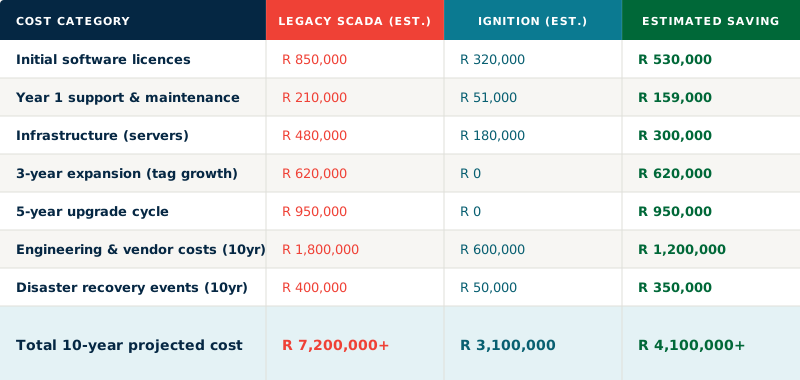
Based on typical project profiles, Ignition delivers approximately 45–55% lower total cost of ownership over a 10-year period compared to traditional legacy SCADA environments with equivalent functionality and scale.
Model Your Environment
Adjust the sliders to match your operation and see your projected 10-year saving.
6. Platform Comparison at a Glance
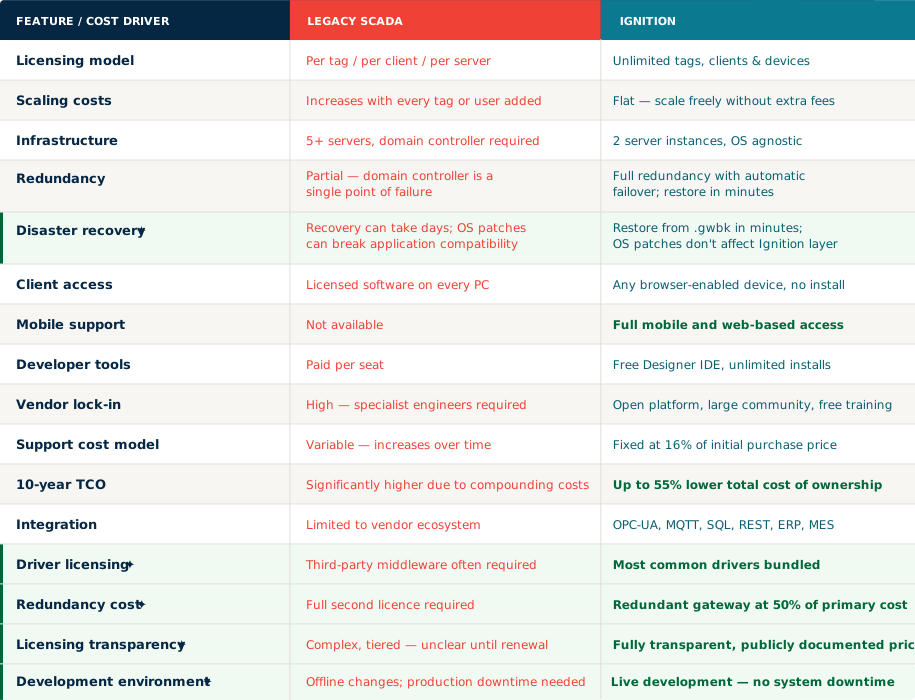
Beyond the financial model, the architectural and operational differences between legacy platforms and Ignition are significant.
8. Operational Improvements Beyond the Balance Sheet
The financial case for moving to Ignition is compelling on its own. But the operational improvements that come with a modern, unified platform often deliver value that is harder to quantify – and in some cases more transformative.
8.1 Faster Development and Deployment
Ignition’s web-based Designer and template-driven development approach dramatically reduces the time required to build new screens, add new equipment, or modify existing logic. What might take days on a legacy system can often be accomplished in hours.
8.2 Enterprise Visibility
With Ignition’s centralised gateway architecture and Perspective module, operational data can be accessed from any device – desktop, tablet, or phone – without installing a single piece of client software. Engineers can monitor plant performance from the office, the boardroom, or the field.
8.3 Unified Platform for SCADA, MES, and Historian
Through its modular design, Ignition can function as the single platform for SCADA visualisation, MES production tracking (via Sepasoft), and historical data logging (via the built-in tag historian or integration with Canary Data Historian). This eliminates separate, siloed systems – and the integration costs that come with maintaining them.
8.4 Live Development Enviroment
One of the more underappreciated advantages of Ignition is its live development environment. Changes can be made, tested, and deployed without taking the system offline – meaning development work does not require planned downtime or production shutdowns. This significantly reduces the engineering hours required per project, and allows integrators and internal teams to iterate quickly without operational disruption.
8.5 Cybersecurity and IT Alignment
Ignition uses a single network port (8088 or 8043 for SSL), supports Active Directory, LDAP, Okta, and other identity providers, and can be configured to meet OT cybersecurity standards. This makes it significantly easier for IT teams to secure and manage compared to legacy platforms that require open domain controller access and multiple firewall rules.
9. Why South African Industrial Organisations Are Moving to Ignition
We have had the privilege of working alongside some of the most respected industrial organisations in South Africa – from platinum and gold mining operations to water treatment facilities and manufacturing plants. The conversations are converging on the same themes.
- Cost predictability: organisations want to know what their SCADA will cost in Year 7, not just Year 1.
- Scalability without penalty: the ability to add tags, users, and sites without triggering a new licensing event.
- Skills and talent: a platform that engineers want to learn, with free training and a global community.
- IT/OT convergence: a system that IT can understand, secure, and support.
- Digital transformation readiness: a foundation that connects to cloud, ERP, MES, and AI platforms.
Ignition does not ask organisations to rip and replace everything overnight. It is designed to coexist with existing infrastructure, connect to legacy historians and PLCs, and expand incrementally – at a pace that matches the organisation’s readiness and budget.
The Question Worth Asking
Legacy SCADA systems are not just a technology risk. They are a long-term financial commitment that compounds quietly in the background – through licensing growth, infrastructure dependencies, vendor lock-in, and the engineering costs of a platform that was never designed for today’s environment.
When organisations take the time to model the true 10-year total cost of ownership – not just the renewal invoice – the case for modernisation becomes difficult to ignore. And for many, the conversation that starts with “how much does Ignition cost?” ends with “how soon can we start?”
Ready to run the numbers on your environment?
We are happy to walk through a cost comparison specific to your operation, no pressure, just an honest look at the numbers.
About Ignition
Ignition by Inductive Automation is a web-based, cross-platform SCADA, HMI, and IIoT solution built on a server-centric architecture with an unlimited licensing model. Ignition 8.3 is the platform’s most substantial release to date and its first long-term support (LTS) version – introducing a redesigned Gateway UI, a built-in REST API, JSON-based project files for Git version control, a new Power Historian engine, Event Streams for data pipeline management, Siemens S7 driver support, and OPC UA 1.05 compliance. Visit inductiveautomation.com.
About Concera
Concera is a Premier Ignition integrator and trusted partner of Element8 across South Africa. The cost analysis, infrastructure comparisons, and 10-year TCO projections in this article were developed by the Concera team, drawing on hands-on experience delivering Ignition-based solutions across mining, manufacturing, and industrial environments.
Disclaimer: Cost figures in this article are indicative estimates based on real project experience and current market pricing. Actual costs will vary based on project scope, vendor negotiations, and operational context. All Rand values are approximate and should be validated against current vendor pricing.
